What is Cyclodextrin
What is Cyclodextrin
- Detail
What is Cyclodextrin?
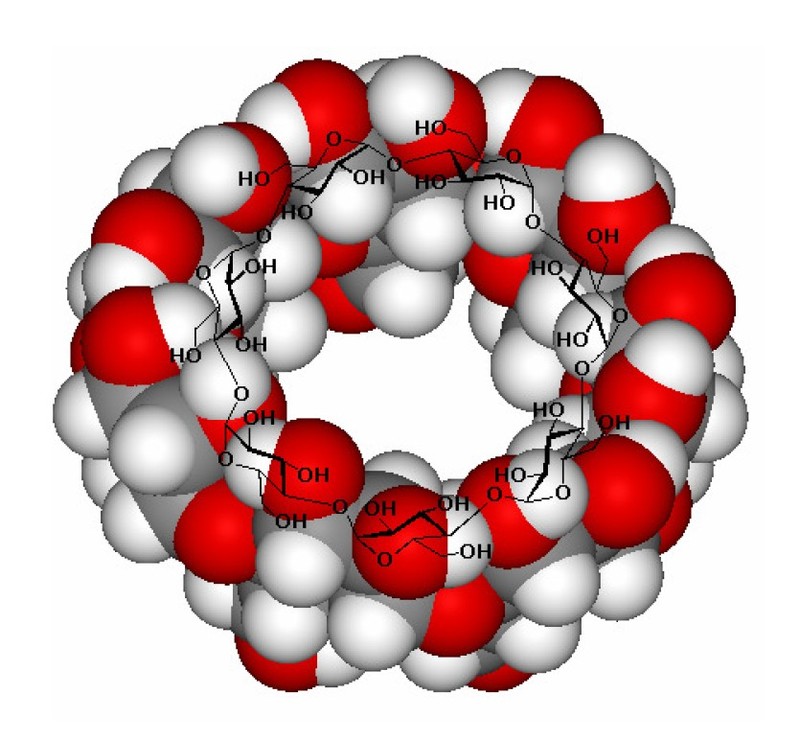
Cyclodextrinsare crystalline, water soluble, cyclic, non-reducing, oligosaccharides built upfrom six, seven, or eight glucopyranose units. Three naturally occurring CDs are alpha Cyclodextrin, beta Cyclodextrin,and gamma Cyclodextrin. All the hydroxyl groups in Cyclodextrins are orientedto the outside of the ring while the glucosidic oxygen and two rings of thenon-exchangeable hydrogen atoms are directed towards the interior of thecavity. This combination gives Cyclodextrins a hydrophobic inner cavity and ahydrophilic exterior. The hydrophobic internal cavity provides the capabilityto form inclusion complexes with a variety of "guest" hydrophobicmolecules (e.g. aromatics, alcohols, halides, fatty acids, esters, etc.).
How does Cyclodextrin look like?
Cyclodextrins have a specific toroidal shape: a tight conical cylinder witha hydrophilic exterior (due to the presence of hydroxyl radicals) and ahydrophobic cavity of a specific size. Generally 6 - 8 sugar units.
What are the types of Cyclodextrin?
Natural Cyclodextrins
The most common cyclodextrins are alpha, beta, and gamma cyclodextrins havingsix (α), seven (β), or eight (γ) anhydroglucose units in the ring structure.Among them, beta Cyclodextrin is mostly common used.
Different sizes lead to different physicochemical characteristics for therespective molecules:
Characteristics | Alpha (α) | Beta (β) | Gamma (γ) |
Number of glucose units | 6 | 7 | 8 |
Molecular weight | 972 | 1135 | 1297 |
Water solubility(g/100ml), 25° C | 14.5 | 1.85 | 23.2 |
Cavity diameter (nm) | 0.57 | 0.78 | 0.95 |
Height of torus (nm) | 0.78 | 0.78 | 0.78 |
Chemically modified Cyclodextrins
Cyclodextrins can be modified by various proceduressuch as:
Substituting oneor more hydrogen atoms in the primary and/or secondary hydroxyl groups (esters,ethers, glycosylcyclodextrin)
Substituting oneor more primary and/or secondary hydroxyl groups
Chemically modified Cyclodextrins (CDM's) exhibitsubstantially increased aqueous solubility with concomitant retention of theinclusion complexing properties of the starting Cyclodextrin. They thereforeappear to offer specific applications within various industries, such as foods,pharmaceuticals, personal care/cosmetics, diagnostics, etc. Hydroxyalkyl bCyclodextrins such as Hydroxypropyl b Cyclodextrin are examples of thosechemically modified Cyclodextrins.
How does Cyclodextrin work?
Cyclodextrin inclusion is a molecular phenomenon in which usually only oneguest molecule interacts with the cavity of a Cyclodextrin molecule to becomeentrapped and form a stable association. Molecules or functional groups ofmolecules those are less hydrophilic than water, can be included in theCyclodextrin cavity in the presence of water.
In order to become complex, the "guest molecules" should fit, atleast partly, into the Cyclodextrin cavity. The cavity sizes as well aspossible chemical modifications determine the affinity of Cyclodextrins to thevarious molecules. In the case of some low molecular weight molecules, morethan one guest molecule may fit into the cavity. On the opposite, some highmolecular weight molecules may bind more than one Cyclodextrin molecule.Therefore a 1 to1 molar ratio is not always achieved, which broadens the rangeof applications.
Cyclodextrins are able to form inclusion complexes with broad range hydrophobicmolecules as poorly soluble drugs, rapidly deteriorating flavours, volatilefragrances, toxic pesticides or dangerous explosives, even gases; entrappingthese substances in their inner cavities. For example, a-Cyclodextrin formsinclusion complexes with both aliphatic hydrocarbons and gases, such as carbondioxide. B-Cyclodextrin typically forms complexes with small aromaticmolecules. G-Cyclodextrin can accept more bulky compounds, including vitamin D2or organic macro cycles.
This results in the physical and chemical characteristics of the guestmolecules:
In the solid state:
 Theguest molecule is molecularly dispersed in the CD matrix, even with gaseousguest molecules.
Theguest molecule is effectively protected against any type of reaction, exceptwith CD's hydroxyls.
Sublimation and volatility are reduced to avery low level.
In aqueous solution:
Concentrationof the poorly soluble guest molecule in the dissolved phase increasessignificantly.
Reactivity of the guest molecule decreasesin most cases.
The diffusion and volatility of the includedguest decrease significantly.
What does Cyclodextrin do?
1. Solubilization:
Enhancementof water solubility of lipophilics
Change of rheological Properties Increase ofbioavailability
2. Stabilization
Of anactive ingredient
Of an emulsion
Of a volatile compound
Against UV light
Against temperature
Against Oxidation
Against hydrolysis
3. Reduction of
Badtaste
Unpleasant odour
Skin irritation
Hygroscopicity
4. Controlled release of actives
5. Selective extraction
Ink Industry:
Water soluble dyes in water based systems forink jet printers
Water resistance - fixing characteristics inink jet printers
Water resistance in thermal ink jet printing
Aqueous composition/wettability in writingustencils
Greater florescent yield in highlighter pen
Fragrance /Flavour:
Controlled release (ex : Chewing-gum flavor).
Complexation of perfumes/oils
Food:
Selective extraction of Naringen& limonenfrom citrus juice
Selective extraction of caffeine fromtea/coffee.
Selective extraction of pigments which areprecursors of enzymic browning of fruit juices.
Complexation of triglycerides in vegetableoils with a high content of polyunsaturated fatty acids to improve stability.
Cosmetics:
Reduced irritancy of fragrances in shampoos
Controlled release of actives (ex :fragrance in body lotion)
Protection of actives against oxidization
Skin treatment of acne, through complexationof sebum.
Foot deodorants
Increased stability of antiplaque toothpaste
Higher concentration of lipophilicsubstances in aqueous emulsions (ex: face lotions)
Masking unpleasant odour of a volatilecompound (ex: mercaptan in permanent wave product / self tanning products).